

Tickets are booked, your passport is ready and your bags are almost packed. Most people feel the hard part is over at this point. But many traveller’s read their international flight baggage rules only when they reach the check-in counter, and that is often where the trouble begins.
A bag can be under the weight limit and still be refused because it is too big or has a banned item inside. Limits also change with the airline, the route, the fare and the cabin class.
Spend a few minutes on the international flight baggage rules for your booking before you start packing, and you can avoid a lot of stress.
1. Baggage Allowance: How much you can carry ?
The international flight baggage rules are not the same for every airline, so there is no single allowance that fits all. Your ticket may include a cabin bag, a checked bag, a small personal item, or a fixed number of pieces with a weight cap on each one.
Some airlines count the total weight of your bags. Others count the number of bags. So do not take it for granted that 23 kg of checked baggage is part of your fare.
Before you pack, look at four things: weight, size, number of bags and fare type.
Many airlines allow about 7 kg in the cabin, but the exact figure depends on your fare. Your e-ticket will show it.
Learn more: Air India — Cabin Baggage Guidelines (example of an airline policy)
2. Cabin Bag or Checked Bag: What goes where ?
An easy rule is to keep anything important or costly with you. Your cabin bag is the right place for:
- Passport and travel documents
- Phone and laptop
- Necessary medicines
- Wallet and valuables
- Camera and other electronics
- Chargers
Clothes, shoes and other allowed items can go in your checked bag.
Ask yourself one question: if this item got lost, would it spoil my trip? If yes, carry it with you.

3. Weight and Size Limits: The Scale Does Not Tell the Whole Story
Many people check only the weight of the suitcase. That is just half the job, because airlines also set a maximum size. A light bag can still be turned away if it is too large.
Airlines usually follow one of two systems:
Weight system: you get a total weight allowance to use across your bags.
Piece system: you get a set number of bags, and each bag has its own limit.
Read the full allowance in the international flight baggage rules for your ticket, not only the kilograms. This helps you avoid repacking and extra charges at the airport.
4. International Baggage Rules for Liquids, Food and Medicines
Small mistakes in packing can cause big delays, even when you follow the international flight baggage rules. In cabin baggage, liquids, gels and aerosols are usually limited to 100 ml per container, and all containers normally have to fit in one clear, resealable bag. Security rules often make exceptions for essential medicines and baby food.
Note that a shampoo bottle that is half empty can still be stopped, because the size of the bottle is what counts. Small travel bottles solve this problem.
Food needs a check too under the international flight baggage rules. Dry, packed food is often treated differently from liquids and fresh items. Also remember that the country you are flying to may have its own customs rules. Something that passes airport security may still not be allowed into another country.
If you carry prescription medicines, keep them where you can reach them quickly, and take the papers that support them if they are required.
Learn more: Delhi Airport — Security & Baggage Rules
5. Power Banks and Electronic: keep Them with You
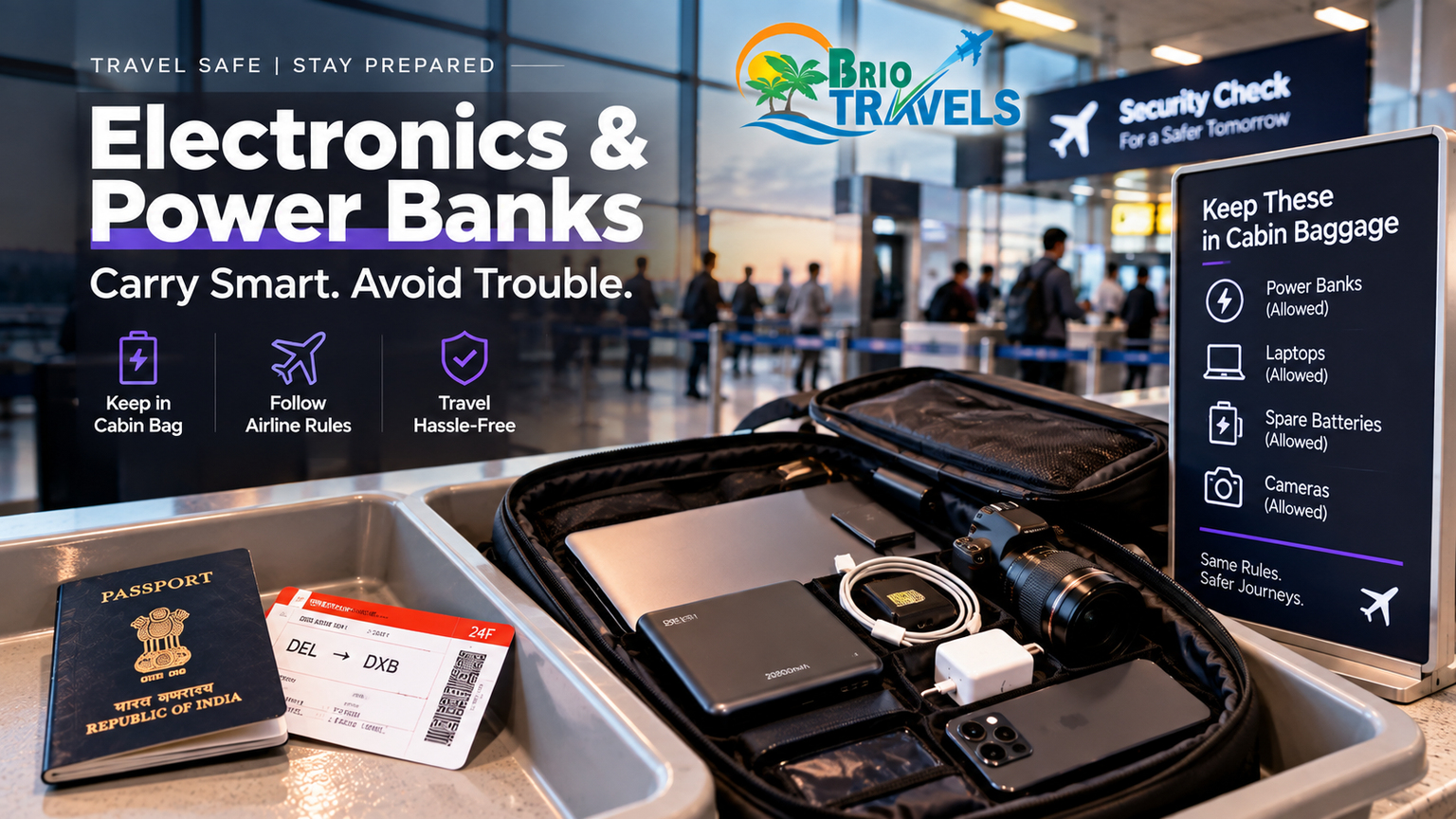
Most international flight baggage rules, power banks and spare lithium batteries must travel in the cabin bag and Under not in checked luggage. Current IATA passenger guidance allows up to two power banks per traveller , and each one must be 100Wh or less. Some airlines are stricter, so read the policy for your own flight.
Keep these in your cabin bag:
- Power banks
- Spare batteries
- Laptop and other important electronics
- Camera and other battery-powered devices
If you have a large battery or unusual electronic equipment, ask the airline about its battery rules before the day of travel.
6. Items you should Not pack without checking
Under most international flight baggage rules, power banks and spare lithium batteries must travel in the cabin bag and not in checked luggage. Current IATA passenger guidance allows up to two power banks per traveller, and each one must be 100Wh or less. Some airlines are stricter, so read the policy for your own flight.
Keep these in your cabin bag:
- Power banks
- Spare batteries
- Laptop and other important electronics
- Camera and other battery-powered devices
If you have a large battery or unusual electronic equipment, ask the airline about its battery rules before the day of travel.
7. International Flight Baggage Rules for Overweight Bags: What Happens Next?
Suppose your allowance is 23 kg and your suitcase weighs 27 kg at check-in. Depending on the airline, you may be asked to:
- Take some items out
- Repack the suitcase
- Shift allowed items into another bag
- Buy extra baggage
- Pay an excess baggage fee
Weigh your bag at home after reading the international flight baggage rules for your ticket. If you already expect a heavy bag, compare the airline’s advance baggage options before you leave for the airport. Extra baggage bought online in advance can cost less than paying at the counter, though this is not the case with every airline.
8. Special Baggage: Carrying Something Unusual ?
Sports gear, musical instruments, wheelchairs, baby strollers and oversized items may need special handling or an extra fee.
Do not leave these questions for check-in. Read the international flight baggage rules for special items, or contact the airline, well before your travel date.
9. Lost or Delayed Baggage: What Should You Do ?
If your bag does not show up on the belt, go to the airline’s baggage desk before you leave the airport. Ask for a Property Irregularity Report (PIR) and note down the reference number.
Keep your baggage tag, boarding pass and PIR or claim reference in a safe place.
This is another reason to keep essential medicines, documents, valuables and one change of clothes in your cabin bag.
Claims have time limits. Under the Montreal Convention, damage to checked baggage should generally be reported in writing within 7 days, and a delay within 21 days. Check the airline’s procedure and the rules that apply to your journey.
10. Quick 10-Minute Baggage Check Before Your Flight
✓ Is my bag within the weight limit?
✓ Does it fit the airline’s size limit?
✓ Is my power bank in the cabin bag?
✓ Are my liquids packed the right way?
✓ Can I reach my passport and documents easily?
✓ Are my valuables in the cabin bag?
✓ Have I checked the rules for my medicines?
✓ Have I checked what my destination country does not allow?
✓ Do I know the airline’s excess baggage charges?
✓ Have I saved the airline’s latest baggage policy?
Ten minutes with this list and the international flight baggage rules at home can save you time, repacking and surprise charges at the airport.
Final Thoughts on International Flight Baggage Rules
Air travel is much smoother when you read the international flight baggage rules a few days before you fly, not on the day. Weight is only one piece of the picture. Bag size, number of bags, liquids, batteries, banned items and the rules of the country you are visiting all matter.
Before you leave, read the airline’s latest policy, weigh your bags and keep your important things in the cabin bag. A little preparation makes check-in easier.
Planning Your Next International Trip? Explore our Visa Free Countries for Indians guide for more travel planning tips.
“Brio Travels’ travel guides
1. How much baggage can I take on an international flight?
It depends on the airline, route, fare and cabin class. Your e-ticket or the airline’s official baggage page shows the exact allowance.
2. Can I put a power bank in checked baggage?
No, power banks and spare lithium batteries should normally go in your cabin bag. Current IATA passenger guidance allows two power banks, each up to 100Wh, and some airlines set tighter limits.
3. What are the international flight baggage rules for baggage allowance?
It depends on the airline, route, fare and cabin class. Your e-ticket or the airline’s official baggage page shows the exact allowance
4. What if my bag is overweight?
Depending on the airline, you may have to repack, buy extra baggage or pay a fee.
5. Where can I find the baggage rules for my ticket?
Check the international flight baggage rules on your e-ticket, the airline’s official baggage page and the fare conditions. Two fares on the same airline can come with different allowances.
6. What do international flight baggage rules say about checked baggage?
International flight baggage rules vary by airline, route, fare and cabin class. Check your e-ticket or the airline’s official baggage page for the exact weight, size and number of bags allowed.
7. What do international flight baggage rules say about power banks?
Under international flight baggage rules, power banks and spare lithium batteries should normally be carried in your cabin bag, not checked baggage. Some airlines may have stricter limits, so check your airline’s policy before travelling
Planning Your International Trip with Brio Travels?
Brio Travels can help you plan your flights, hotels and complete trip in one place. Our team can help you choose suitable travel options and organise the journey, so your planning stays simple and free of last-minute problems.