

Planning an international holiday involves more than booking flights and choosing a hotel. You also need a practical way to pay for meals, transport, shopping and emergencies after you arrive. Understanding currency exchange before departure can help you avoid poor rates, unnecessary fees and last-minute stress at the airport.
A planned currency exchange strategy is therefore an essential part of preparing for an overseas trip.
Many first-time travellers simply compare the displayed exchange rate and choose the provider offering the biggest number. That can be an expensive mistake. The amount you finally receive depends on the buying or selling rate, service charges, conversion markups and payment method.
A good travel-money plan compares the complete cost—not just the headline rate.
This guide explains how foreign currency exchange works, where you can buy travel money and how to choose between cash, cards and digital payment options.
What Is Currency Exchange?
Currency exchange is the process of converting the money of one country into the currency used by another.
For example, an Indian traveller visiting France may convert Indian rupees into euros. Someone travelling to Thailand may purchase Thai baht, while a Dubai visitor will need UAE dirhams.
The conversion takes place according to the prevailing foreign exchange rate. This rate indicates how much of one currency you receive in return for another.
Because exchange rates move continuously in global markets, the amount offered today may differ from the amount available next week.
Banks, authorised money changers and online forex platforms usually add a margin or service charge to the market rate. Consequently, the rate shown on a financial website is rarely the exact rate a traveller receives.
How Do Currency Exchange Rates Work?
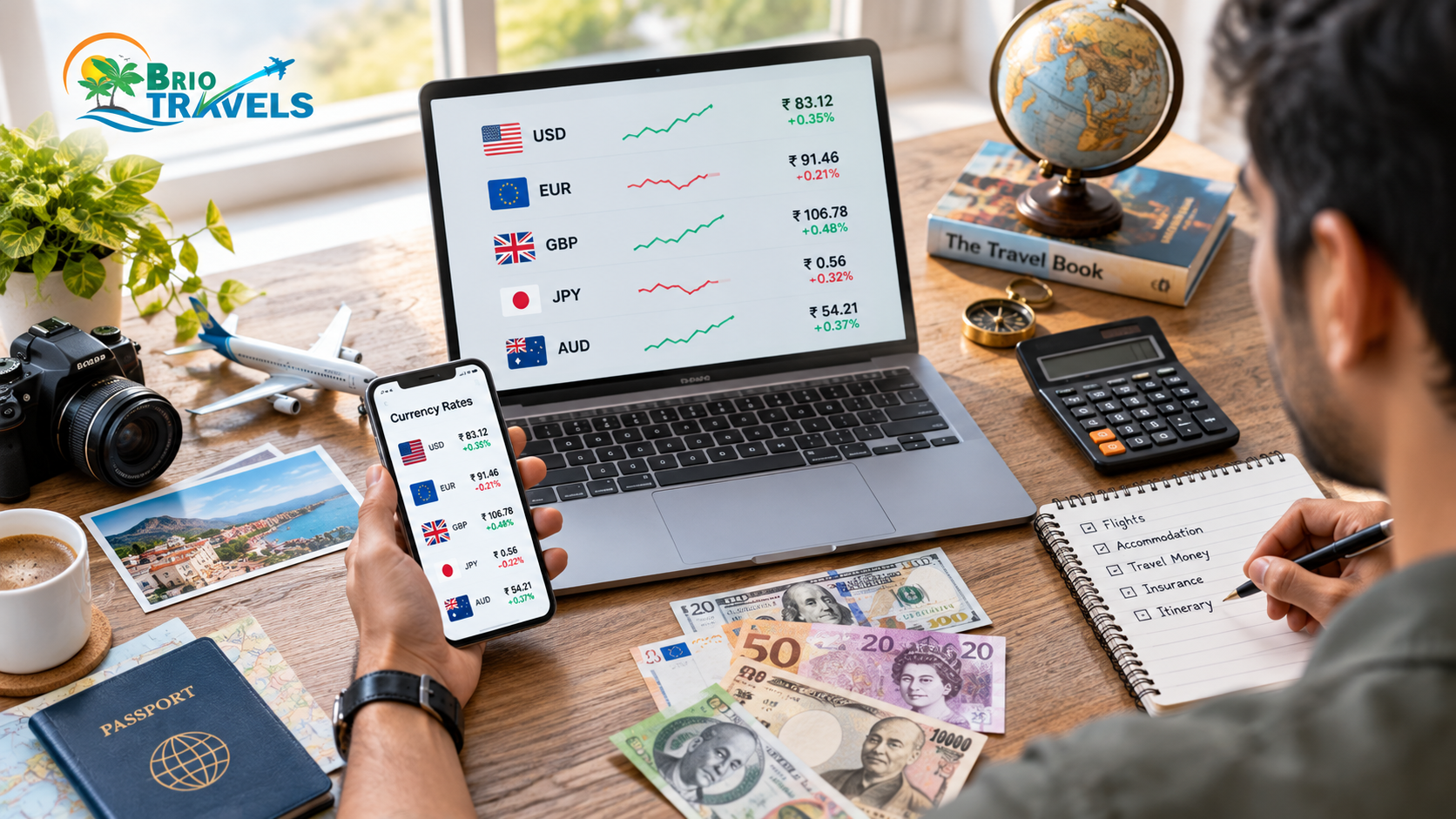
Foreign exchange rates are influenced by several factors, including:
- Inflation
- Interest rates
- Economic conditions
- International trade
- Demand for a currency
- Political developments
- Market expectations
Suppose the indicative market rate is ₹90 for one US dollar. A provider may sell a dollar to you for ₹91.50 and buy it back for ₹88.50.
The difference between these rates is known as the spread. It is one of the ways a currency exchange provider earns money.
Travellers should understand three common rate-related terms.
Mid-Market Rate
The mid-market or interbank rate is the midpoint between the global buying and selling prices of a currency.
It is useful as a reference, but retail customers normally cannot purchase foreign cash at this exact rate.
Selling Rate
The selling rate is the price at which a bank or forex provider sells foreign currency to you. When leaving India, this is generally the figure that matters.
Buying Rate
The buying rate is the price at which the provider buys unused foreign money from you.
It becomes relevant when you return from your trip and want to convert leftover cash into Indian rupees.
Why Planning Your Currency Exchange Matters
Leaving your currency exchange until you reach the airport may be convenient, but that convenience can come with a weaker rate or higher fees.
Planning early allows you to compare providers, confirm the required documents and decide how much money to carry in each form.
An effective plan can help you:
- Avoid exchanging your entire budget at an unfavourable rate
- Reduce ATM withdrawal and card-conversion charges
- Keep enough cash for arrival expenses
- Avoid carrying excessive physical money
- Create a backup if a card is blocked, lost or declined
- Track spending more accurately during the trip
The objective is not to predict the perfect exchange rate. Currency movements are uncertain.
The realistic goal is to avoid preventable charges and create a safe combination of payment methods.
Where Can You Exchange Foreign Currency?
International travellers have several currency exchange options. The right choice depends on the destination, amount required, available time and total charges.
- Banks
Many banks provide foreign currency notes and prepaid forex cards.
Banks are familiar and regulated, making them a dependable option for travellers who prefer dealing with their existing financial institution.
However, not every branch keeps every currency in stock. Processing time, availability and rates can also vary.
Contact the branch before visiting and compare the final payable amount rather than assuming your bank will automatically be the cheapest option.
- Authorised Money Changers
Authorised money changers specialise in buying and selling foreign currency.
They may offer competitive rates, especially for commonly requested currencies such as:
- US dollars
- Euros
- British pounds
- UAE dirhams
- Thai baht
Use only an RBI-authorised dealer or Full-Fledged Money Changer.
Ask for a transaction receipt and keep it until your trip is complete. Avoid informal dealers, even when they promise an unusually attractive rate. Counterfeit notes and illegal transactions are not worth the supposed saving.
- Online Forex Platforms
Online currency exchange services allow travellers to compare rates, upload documents and request delivery or collection.
They can be convenient when you want to organise your travel money before departure.
Check whether the quoted price includes:
- Home delivery
- Forex-card loading
- Taxes
- Service charges
- Payment-processing fees
You should also verify the provider’s authorisation, cancellation policy and delivery timeline before making any payment.
- Airport Exchange Counters
Airport currency exchange counters are useful when you urgently need a small amount of local money. Their convenient location and extended operating hours are their main advantages.
However, they should usually be treated as a backup rather than the default choice.
Limited competition and high operating costs can result in a wider exchange-rate spread or additional fees.
If necessary, exchange only enough money for immediate transport, food or other arrival expenses. You can obtain the remaining amount through a better-value option later.
- ATMs at Your Destination
Withdrawing local currency from an ATM can be convenient, but the total cost may include:
- A local ATM fee
- A withdrawal fee from your Indian bank
- A foreign-currency markup
- Applicable taxes
- Dynamic currency conversion charges
Some overseas ATMs offer to convert the withdrawal into Indian rupees. This is called dynamic currency conversion and often uses a less favourable rate.
When given a choice, select the destination’s local currency. This generally allows your card network or issuer to perform the conversion.
Review your bank’s international withdrawal charges before relying on ATMs.
Currency Exchange at a Bank vs the Airport
There is no single currency exchange provider that is always the cheapest. However, exchanging money before reaching the airport generally gives you more time and options.
| Factor | Bank or authorised provider | Airport counter |
| Convenience | Requires advance planning | Immediate and accessible |
| Rate comparison | Easier to compare providers | Limited choices |
| Currency availability | May require advance booking | Major currencies usually available |
| Charges | Often more competitive | May include a wider margin |
| Best use | Planned travel budget | Small emergency amount |
Always compare how much foreign currency you will receive for the same final rupee payment.
A “zero commission” offer is not automatically cheaper because the provider may build its margin into the exchange rate.
Cash, Forex Card or Credit Card: What Should You Choose?

Relying on a single payment method creates unnecessary risk. Most travellers are better served by a planned combination.
Foreign Currency Cash
Cash is useful for:
- Local markets
- Taxis
- Tips
- Small shops
- Cash-only businesses
- Network failures
Its disadvantages include theft risk, limited recovery if lost and the cost of reconverting unused notes.
Prepaid Forex Card
A forex card is loaded with one or more foreign currencies before your trip.
It can make budgeting easier and may protect you from later exchange-rate movements for the amount already loaded.
However, fees may apply for:
- Card issuance
- Reloading
- ATM withdrawals
- Inactivity
- Balance refunds
- Card replacement
Read the complete schedule of charges before choosing a forex card.
International Debit or Credit Card
Cards are convenient for hotels, restaurants, shopping and larger purchases.
Depending on the issuer, international transactions may include a foreign-currency markup and applicable taxes.
Credit-card cash withdrawals can be particularly expensive because cash-advance fees and interest may apply immediately.
A sensible arrangement is to carry limited cash for immediate and small expenses, one primary card and a separate backup card.
Store your cards separately so that one lost wallet does not remove every payment option.
How Much Foreign Currency Should You Carry?
There is no universal amount that works for every traveller.
Estimate your cash requirement using:
- Your destination
- Trip duration
- Prepaid bookings
- Local payment habits
- Planned activities
- Emergency requirements
Create a simple daily budget covering:
- Airport transfers
- Local transport
- Meals not included in your package
- Entry tickets
- Small activities
- Tips
- Local purchases
- Emergency expensesIf your hotels, major transport and tours are prepaid, you may need only a modest amount of physical money.Cash-dependent destinations may require more. However, avoid carrying your entire travel budget in banknotes simply because it feels easier.Indian residents should also consider current foreign-exchange regulations.The Reserve Bank of India’s Liberalised Remittance Scheme generally permits resident individuals to use up to USD 250,000 per financial year across permitted purposes, including private visits, subject to applicable conditions.Cash-note limits and documentation requirements can be more restrictive than the overall LRS ceiling.
Confirm the current rules with an authorised dealer before purchasing a large amount because regulations and tax treatment can change.
Documents Required for Currency Exchange in India
Requirements can vary according to the provider, transaction value and purpose.
Travellers are commonly asked for:
- A valid passport
- Confirmed flight tickets or travel details
- A valid visa, where required
- PAN or another required tax identifier
- Address or identity proof
- A completed application or declaration
The provider may request additional information to meet KYC and foreign-exchange regulations.
Carry original documents where required and use matching details across your passport, ticket and payment records.
Never submit false travel information to obtain foreign currency.
Hidden Currency Exchange Charges
A strong advertised currency exchange rate can become a poor deal after additional charges are included.
Check for:
- Exchange-rate markup or spread
- Service or handling charges
- Home-delivery fees
- Forex-card issuance fees
- Card reload fees
- ATM withdrawal charges
- Foreign-transaction markup
- Dynamic currency conversion
- Buyback or encashment fees
- Applicable taxes or tax collection
Compare providers using one simple question:
How much usable foreign currency will I receive after paying the complete cost?
This is more reliable than comparing promotional terms such as “best rate” or “zero commission.”
How to Get a Better Currency Exchange Deal
Compare the Total Cost
Request quotes for the same currency and amount from at least two or three authorised providers.
Make sure every quote includes all mandatory charges.
Avoid Panic Buying
Arrange the required foreign currency a few working days before departure.
Waiting until the final hour reduces your ability to compare options and can create currency-availability problems.
Exchange Money in Stages
For a large travel budget, purchasing currency in two or more stages may reduce the risk of converting everything on a particularly unfavorable day.
It will not guarantee a better average rate, but it prevents your entire decision from depending on one day’s price.
Decline Dynamic Currency Conversion
When an overseas card terminal or ATM asks whether you want to pay in Indian rupees or local currency, choosing local currency generally avoids the merchant’s conversion rate.
Your card issuer will then perform the currency conversion according to its terms.
Notify Your Bank Before Departure
Before travelling:
- Enable international transactions
- Check daily spending limits
- Confirm your registered phone number
- Review international ATM charges
- Learn how to block a lost card
- Save the international customer-care number separately
Keep Your Currency Exchange Receipts
Receipts provide a record of a legitimate foreign currency transaction.
They may be useful when reconverting unused money and make it easier to verify the rate and charges applied.
Common Currency Exchange Mistakes
Travellers frequently lose money through simple and avoidable decisions:
- Exchanging the entire budget at an airport counter
- Comparing only the displayed rate and ignoring fees
- Carrying too much cash in one wallet
- Using an unauthorised street dealer
- Accepting conversion into INR at an overseas ATM
- Depending on one card without a backup
- Forgetting to check international card limits
- Ignoring ATM withdrawal charges
- Returning with excessive unused foreign cash
- Choosing a “zero commission” deal without checking the exchange rate
The cheapest method is not always the safest, and the most convenient method is rarely the cheapest.
Good planning balances cost, accessibility and security.
What Should You Do With Leftover Foreign Currency?
Small notes and coins can be saved for a future visit, although many providers do not accept coins for buyback.
If you do not expect to return, use the remaining balance for legitimate final expenses or exchange accepted banknotes through an authorised provider after reaching India.
Do not deliberately purchase excessive foreign cash.
The difference between the selling and buying rates means you may lose money when converting it back into rupees.
Check current RBI rules concerning how much foreign currency an Indian resident may retain after returning from abroad.
Final Currency Exchange Checklist
Before leaving India:
- Estimate your daily cash requirement
- Compare complete quotes from authorised providers
- Verify the provider’s credentials
- Carry a limited amount of destination currency
- Enable international card transactions
- Review card and ATM charges
- Keep a backup payment method separately
- Save emergency contact numbers
- Retain currency exchange receipts
- Recheck current regulatory and tax rules
Final Thoughts
Currency exchange does not need to be complicated.
Start with a realistic travel budget, compare the complete currency exchange cost and use authorised providers.
Instead of carrying everything in cash or relying entirely on one card, create a practical combination of foreign currency, a forex or debit card and a backup option.
The exchange rate is only one part of the decision. Safety, convenience, provider credibility and hidden charges are equally important.
A little preparation before departure can protect your travel budget and help you focus on the experience rather than payment problems.
Important: Foreign-exchange limits, KYC requirements and tax rules can change. Confirm the latest conditions with the Reserve Bank of India, your bank or an RBI-authorised foreign-exchange provider before completing a transaction.
How Much Local Currency Should You Carry for Popular International Destinations?
There is an important difference between minimum cash, proof of funds and a practical travel budget. Most countries do not require every tourist to carry a fixed amount entirely as physical cash.
The following are practical arrival-cash suggestions for one traveller, covering approximately the first one or two days when accommodation and major activities are already paid for.
| Destination | Local currency | Suggested arrival cash | |
| Thailand | Thai baht | THB 3,000–5,000 | |
| Bali, Indonesia | Indonesian rupiah | IDR 1,000,000–1,500,000 | |
| Dubai, UAE | UAE dirham | AED 300–500 | |
| Singapore | Singapore dollar | SGD 100–150 | |
| Vietnam | Vietnamese dong | VND 1,500,000–2,500,000 | |
| Malaysia | Malaysian ringgit | MYR 200–300 |
These are not complete trip budgets or guaranteed immigration requirements. Proof of funds may also include bank statements, forex-card balances or accessible card limits, depending on the country and visa category.
Singapore, for example, advises short-term visitors to possess sufficient funds but does not specify one universal minimum physical-cash amount. Thailand’s proof-of-funds amount can differ according to the entry route or visa category. The UAE also has separate financial requirements for certain tourist-visa categories, which should not be confused with everyday spending cash.
Frequently Asked Questions during currency exchange
-
Is it better to exchange currency before travelling?
Yes. It is sensible to obtain enough destination currency for your immediate arrival expenses before departure.
However, buying your entire travel budget in cash is unnecessary for most trips. Compare the exchange rate and total fees, then combine limited cash with appropriate cards.
-
Is airport currency exchange more expensive?
Airport counters can offer less competitive exchange rates or charge higher fees because travellers have fewer alternatives at the last minute.
Use them for convenience or emergencies, but compare banks, authorised money changers and reputable online providers for planned currency purchases.
-
Should I use cash or a forex card abroad?
Use a combination.
Cash works for small purchases and cash-only businesses, while a forex card or international card is safer for larger payments.
Carry a backup card separately in case your primary option is lost, blocked or declined.
-
What documents are required for currency exchange in India?
Travellers commonly need a valid passport, confirmed travel ticket, visa where applicable, PAN and supporting KYC information.
The exact requirements depend on the authorised provider, transaction amount and purpose of travel.
-
How can I find the best currency exchange rate?
Compare all-inclusive quotes from several authorised providers on the same day.
Examine the selling rate, service fee, delivery cost and other charges. The best deal is the one that provides the most usable foreign currency for the lowest final rupee payment—not necessarily the one advertising zero commission.